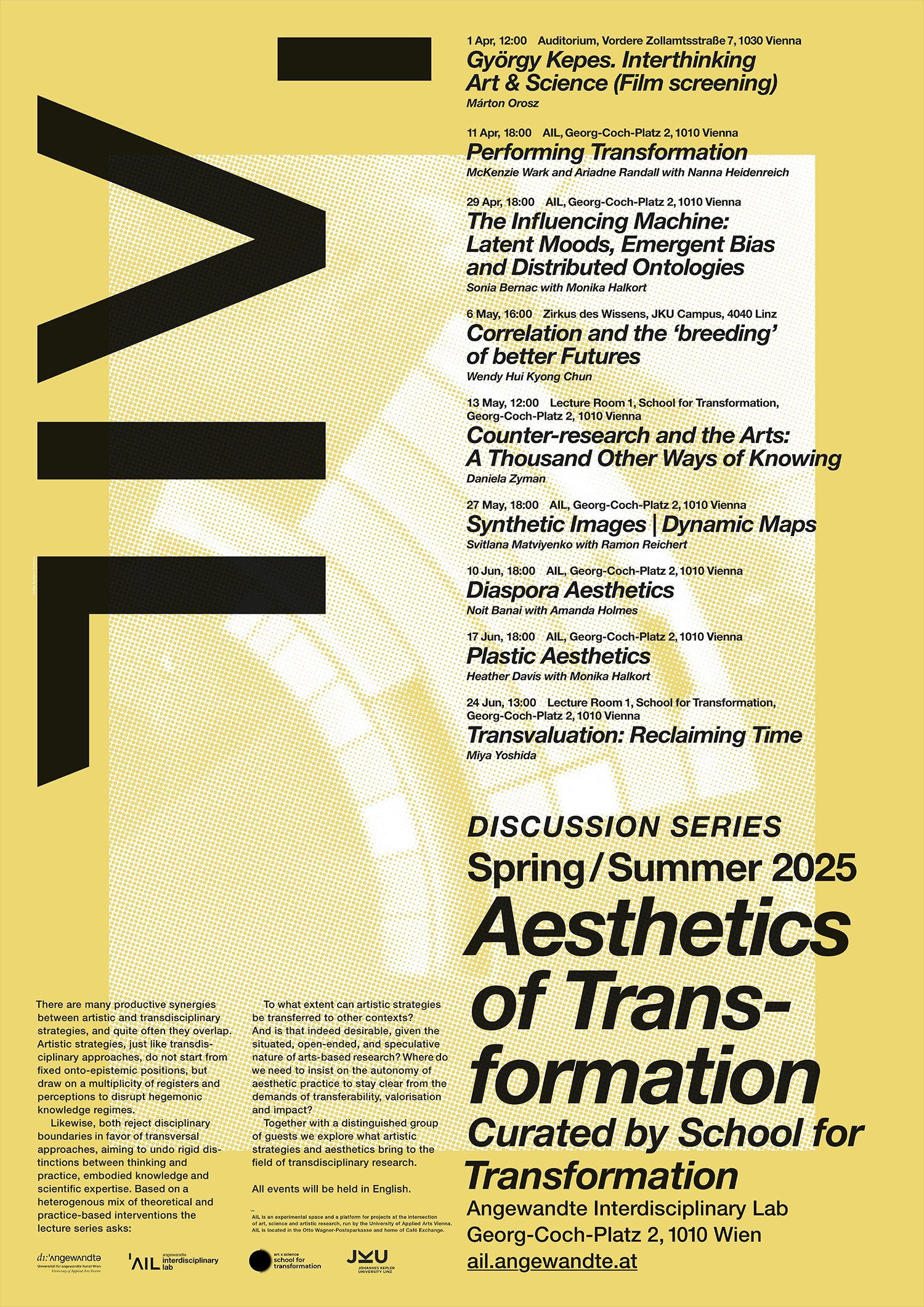
Part
of the lecture series ‘Aesthetics of Transformation’, curated by the School for Transformation
This
talk examines the problem of synthetic emergence: how AI generators, even when guided by loosely defined objectives, tend
to produce commonsensical associations, aesthetic stereotypes, and familiar patterns of meaning.
Rather than
enabling radical experimentation, these systems often resolve into a “canny valley” — a zone of overfamiliar coherence. Though
bias, synthetic “moods,” and aesthetics are not embedded in advance but emerge through systemic operations, their emergence
is frequently steered toward a telos of the familiar. Without reducing the issue to flawed datasets or dismissing AI as a
merely regurgitative “stochastic parrot,” the talk explores the potential of synthetic intelligence and AI media generators
as instruments of poietic praxis — requiring careful attunement to the novel patterns that arise through their experimentation.
It emphasises the importance of distinguishing between different forms of the unknown within these systems, particularly the
differences between randomness, undecidability, and noncomputability — each implying distinct artistic strategies. The ideas
presented are practice-led, discussed through the experimental architecture of Polymorphs — a collaborative series of artworks
and a complex generative AI system developed at the Artificial and Distributed Intelligence Lab, Royal College of Art, London.
Sonia Bernac is an artist, writer, and technologist. Her research investigates the ontological
tensions of old and new materialisms, synthetic teratologies, intuitions of science-fiction, and pre-Enlightenment systems
of knowledge. Framed as a bestiary of distributed intelligence, her work makes sense of hallucinations in generative AI, latent
spaces, and emergent moods within synthetic environments. Without equating the non-human with the inhumane, she pays particular
attention to the emergence of pathological systemic formations – exclusionary, compulsive, or sadistic imaginaries. Most recently,
she was a senior researcher at Antikythera and the Artificial and Distributed Intelligence Lab at the Royal College of Art.
Monika Halkort is assistant professor and head of the Art x Science School for Transformation at
the University of Applied Arts Vienna. Her research and teaching focus on the political ecology of transformation processes,
emphasising, in particular, the role of bio/geo-chemical substances and materials in mediating historical (in)justice and
change.
School for TransformationAIL