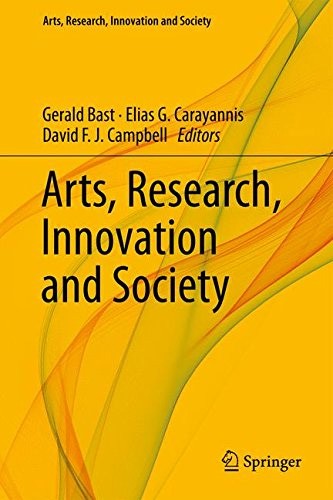
This book explores – at the macro, meso and micro levels
and in terms of qualitative as well as quantitative studies – theories, policies and practices about the contributions of
artistic research and innovations towards defining new forms of knowledge, knowledge production, as well as knowledge diffusion,
absorption and use. Artistic research, artistic innovations and arts-based innovations have been major transformers, as well
as disruptors, of the ways in which societies, economies, and political systems perform. Ramifications here refer to the epistemic
socio-economic, socio-political and socio-technical base and aesthetic considerations on the one hand, as well as to strategies,
policies, and practices on the other, including sustainable enterprise excellence, considerations in the context of knowledge
economies, societies and democracies.
Creativity in general, and the arts in particular, are increasingly recognized
as drivers of cultural, economic, political, social, and scientific innovation and development. This book examines how one
could derive and develop insights in these areas from the four vantage points of Arts, Research, Innovation and Society. Among
the principal questions that are examined include:
- Could and should artists be researchers?
- How
are the systems of the Arts and Sciences connected and/or disconnected?
- What is the impact of the arts in
societal development?
- How are the Arts interrelated with the mechanisms of generating social, scientific
and economic innovation?
As the inaugural book in the Arts, Research, Innovation and Society series, this book
uses a thematically wide spectrum that serves as a general frame of reference for the entire series of books to come.
Authors
Maria Aiolova
Gerald Bast
David F. J. Campbell
Elias G. Carayannis
Alexander Damianisch
Anthony Dunne
Anton Falkeis
Ma Jin
Mitchell Joachim
Richard Jochum
Ruth Mateus-Berr
Ali Pirzadeh
Denisa Popescu
Barbara Putz-Plecko
Fiona Raby
Giaco Schiesser
Vivienne Wang
Peter Weibel