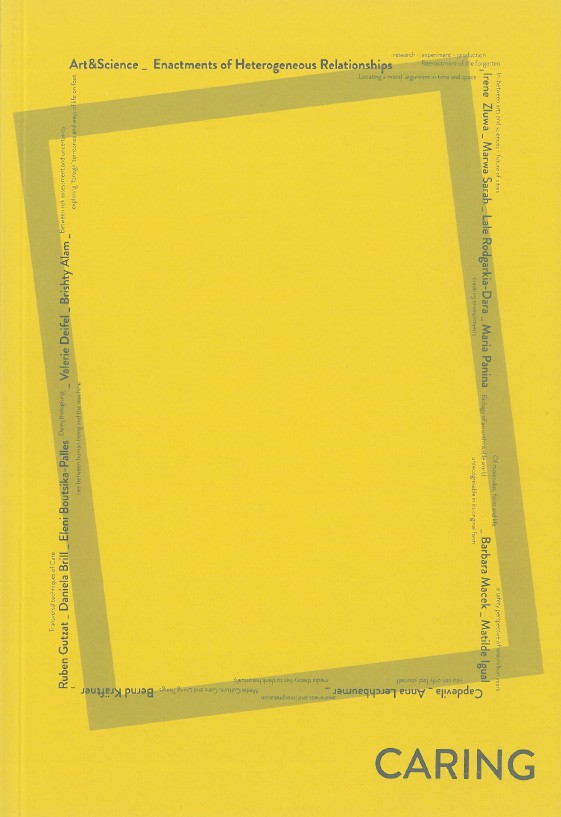
Caring. Enactments of Heterogeneous Relationships
Overall concept
The 2015/16 annual topic ‘Caring’ aims
at exploring the logic of care within different domains. It investigates the role of the deterministic body known by modern
science *and* a fragile body in it’s intricate surroundings. It investigates the individual as autonomous being *and* as relational
being. It investigates the enlightened citizen with a body that does not interfere with his or her plans, cognitive operations,
impartial judgements, firm decisions *and* the citizen in a fleshy, fragile and mortal body situated within continuous inter-dependency.
It investigates interactions within social and material situations where norms are negotiated and practised within these situations
and where those norms do not exist as standards outside of them.
Research catalogue
Artistic activities
and practices use many different media. When texts and language are appropriated and ‘deconstructed’, as a medium, they are
considered as an original artistic genre that forms a tiny part of the arts. However, since the increasing importance of artistic
research in arts-academia and the growing number of collaborations between scientific and artistic disciplines the question
arises what role do we attribute to the written word or (scientific) texts within these projects. Scientific texts usually
are not written for their rhetoric, beauty, or, for the pleasure of reading, they are devices that should produce associations
between many actors and entities with the aim to claim a ‘fact’.
‘The Research Catalogue’ – project aims
at exploring the role of texts within the heterogeneous environment of artistic research. How to study and write about the
ephemeral, indefinite, irregular when facing the normativities of standard methods, when facing their hegemony or monopolies?
How to think of a Research Report as a medium of production and not of describing? Is it possible that knowledge production
and artistic research exposes itself not only via artistic works (displays by means of its traditional formats and media)
and best of possible articulations (construction/representation as knowledge producing situation) but also by experimental
publications?
Students were asked to create a report that reflects these questions by referring to research material
they acquired whilst working on their ‘Caring’ topic. The reports and contributions of the invited guests are compiled in
the research catalogue.
Research reports: Eleni Boutsika-Palles, Daniela Brill, Ruben Gutzat, Bernd Kräftner,
Anna Lerchbaumer, Barbara Macek, Maria Panina, Lale Rodgarkia-Dara, Marwa Sarah, Irene Zluwa
Documentation of guest lectures
& workshops: Brishty Alam, Eleni Boutsika-Palles, Daniela Brill, Valerie Deifel, Ruben Gutzat, Matilde Igual Capdevila,
Anna Lerchbaumer, Barbara Macek, Lale Rodgarkia-Dara, Irene Zluwa
Transcripts & additional materials with courtesy
of the invited guests listed below
Project chair: Bernd Kräftner
In collaboration with: Brishty Alam, Valerie
Deifel
Editor: Bernd Kräftner
Assistant editors: Brishty Alam, Eleni Boutsika-Palles, Valerie Deifel, Ruben Gutzat,
Lale Rodgarkia-Dara, Irene Zluwa
Publication management & copyediting: Brishty Alam, Valerie Deifel
Graphic
design: Eleni Boutsika-Palles
Assistant designer: Matilde Igual Capdevila
Acknowledgements
Thanks
to Virgil Widrich (Art & Science), Anja Seipenbusch (Publication Management/University of Applied Arts Vienna), and Gerald
Bast (Rector/University of Applied Arts Vienna) for their help and support.
Thanks to all of our guests and collaborators:
Luis Aparicio, Peter Berz, Nicole De Brabandere, Judith Fegerl, Norbert Feldmann, Michael Höpfner, Franz Kainberger, Judith
Kröll, Andrea Maier, Florian Menz, Ondřej Merta, Václav Peloušek, Bogdan Popov, Nina Prader, Andreas Spiegl, Thomas Wenzel,
Chris Walzer, Laura Watts